
Biography
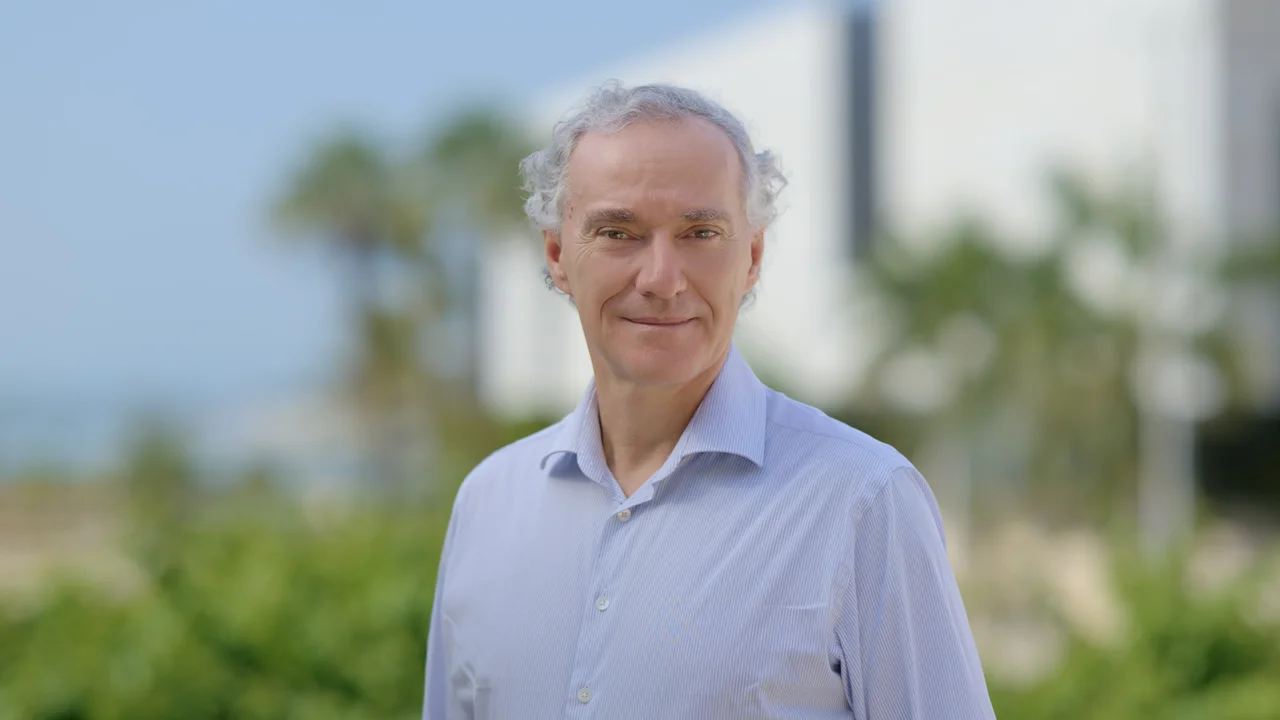
Alessandro Astolfi is professor of applied mathematics and computational science at KAUST and a leading scholar and pioneer in nonlinear systems and control. His research focuses on the analysis and design of advanced control strategies for complex, large-scale, and interconnected systems, with applications spanning robotics, power systems, aerospace, and social and biological systems.
Before joining KAUST, he was professor of nonlinear control theory at Imperial College London and also held professorial appointments at the University of Rome Tor Vergata and Politecnico di Milano.
Astolfi’s work delivers mathematically rigorous methods and algorithms that address engineering challenges. He collaborates closely with academic institutions and industry leaders worldwide, advancing technologies that support infrastructure, energy, and intelligent automation.
An accomplished educator and mentor, Astolfi is committed to developing the next generation of engineers and researchers. At KAUST, he leads interdisciplinary research initiatives and provides master’s and Ph.D. students with opportunities to engage in high-impact projects at the forefront of systems and control theory.
Expertise and Interests
Alessandro Astolfi’s research is focused on the analysis and design of nonlinear control systems and on the development of mathematically rigorous methods that deliver quantifiable and reliable performance in the presence of uncertainty and changing operating conditions.
He has introduced general analytical frameworks and methodologies, including the Immersion and Invariance approach, homogeneous approximation techniques, discontinuous coordinate transformation–based designs, and the notion of nonlinear moment. These tools provide strong theoretical foundations for control design and system analysis.
His work enables the design of scalable, high-performance solutions across a wide range of applications.